Table of Contents
Private prisons pros and cons is one of the most searched debates in the U.S. criminal justice system. Supporters argue for-profit facilities save taxpayer money and ease overcrowding, while critics argue they create financial incentives to keep incarceration rates high. This guide breaks down the real private prisons pros and cons, backed by federal oversight data, so you can understand both sides clearly before forming an opinion.
What Are Private Prisons?
Private prisons are correctional facilities owned and operated by for-profit companies under contract with federal, state, or local governments. Instead of a government agency running the facility directly, a private company handles daily operations, and is paid per inmate, per day, or through a fixed contract fee. Before weighing private prisons pros and cons, it helps to understand this basic business model, since it shapes almost every argument on both sides.
Private Prisons Pros: The Case Supporters Make
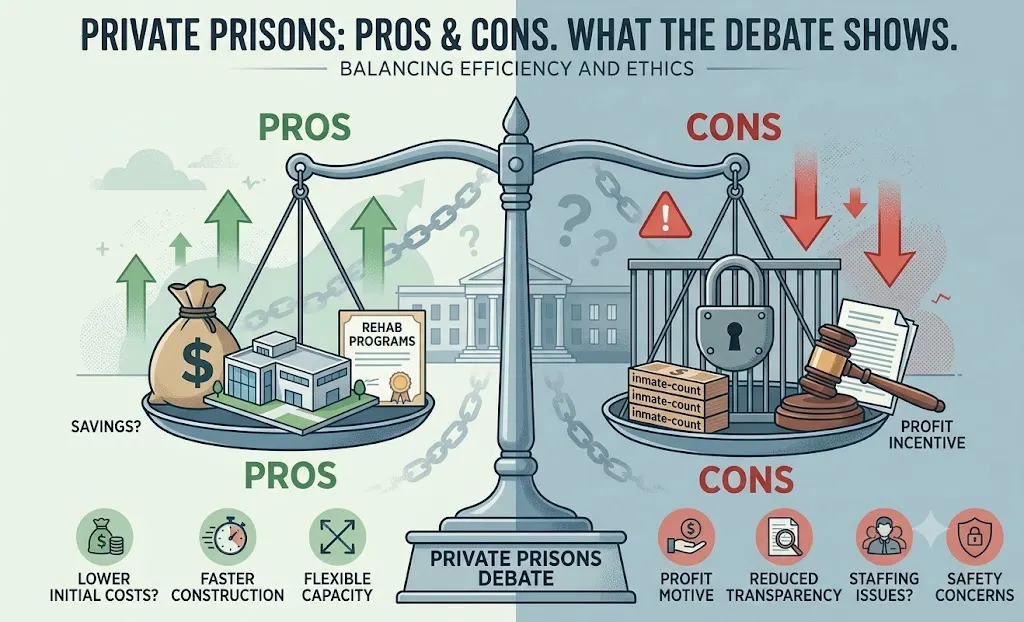
- Lower short-term costs – private operators often claim to build and run facilities more cheaply than government-run prisons.
- Faster construction – private companies can build new facilities more quickly than government agencies, helping relieve overcrowding sooner.
- Flexibility for states – states facing sudden population spikes can contract additional bed space without long-term public investment.
- Specialized programming – some private operators market specialized rehabilitation or reentry programs as a competitive advantage.
Private Prisons Cons: The Case Against Them
- Profit motive tied to incarceration – revenue depends on keeping beds filled, which critics say creates a financial incentive against reducing prison populations.
- Lower staffing and training standards – studies have repeatedly found higher staff turnover and fewer training hours at private facilities compared to public ones.
- Reduced transparency – private companies are often exempt from the same public records laws that apply to government-run prisons.
- Safety and violence concerns – a federal DOJ Inspector General review found contract prisons had more safety and security incidents per capita than comparable Bureau of Prisons facilities.
- Limited long-term savings – independent cost analyses, including research compiled by the Prison Policy Initiative, have found that private prisons often achieve savings by housing healthier, lower-cost inmates, not by operating more efficiently.
Private Prisons Pros and Cons at a Glance
Here is a side-by-side summary of the private prisons pros and cons covered above:
| Argument For | Argument Against |
|---|---|
| Lower upfront construction costs | Profit incentive tied to bed occupancy |
| Faster facility construction | Higher reported staff turnover |
| Added flexible capacity for states | Less public transparency and oversight |
| Specialized rehabilitation marketing | Mixed evidence on actual long-term savings |
Where the Private Prisons Debate Stands Today
Several states have moved to phase out or ban private prison contracts in recent years, citing accountability and cost concerns, while other states continue to rely on them to manage capacity. If you want the bigger picture on where policy is heading, our guide to prison reform solutions for overcrowded prisons covers the alternatives states are testing instead of, or alongside, private contracts. For hard numbers on incarceration trends, see our prison reform statistics guide.
Frequently Asked Questions About Private Prisons Pros and Cons
Do private prisons actually save taxpayers money?
Evidence is mixed. Some studies show modest short-term savings, while others find the savings disappear once you account for the type of inmates housed and the added oversight costs required.
Are private prisons less safe than public prisons?
Multiple government reviews, including the DOJ Inspector General’s report linked above, have found higher rates of violence and lower staffing levels at private facilities, though outcomes vary by state and individual operator.
Which states have banned private prisons?
Several states have passed laws restricting or phasing out private prison contracts in recent years, though enforcement and scope vary, and some bans have faced legal challenges.
What is the alternative to private prisons?
The main alternative is publicly operated, government-run correctional facilities, along with broader criminal justice reform efforts like reduced sentencing and diversion programs that lower the need for additional prison capacity in the first place.