Table of Contents
Ask a man who has been inside since 2005 what he would get today for the same case, and his lawyer will usually tell him: more.
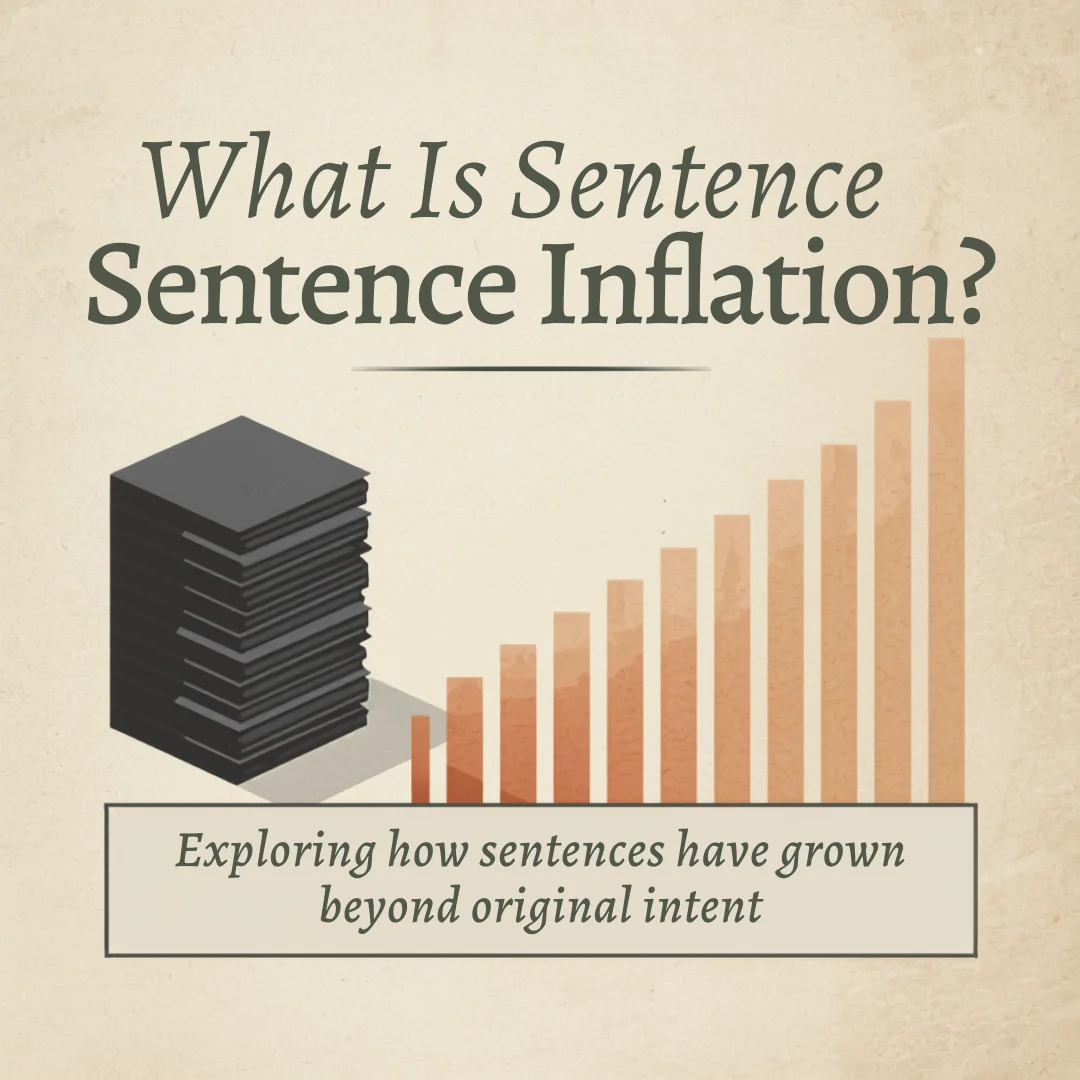
Sentence inflation is the slow rise in how long criminal sentences run, where the same kind of offense draws more prison time now than it did a generation ago. No single law caused it. It accumulated one bill at a time across four decades, and it is a large part of why the United States holds people longer than almost any other country on earth.
For families, this is the part nobody explains in the courtroom. You hear a number. You do not hear why that number exists, or that the same case would have produced a different number in 1985. This is that explanation, and what sentencing reform is trying to do about it.
Sentence Inflation Meaning

Start with what it is not. It is not one policy you can point at and repeal. It is a pattern.
Legislatures add a mandatory penalty here. Raise a minimum there. Attach an enhancement for prior convictions. Tighten the rules on release. Any one of those reads as modest on its own. Stack forty years of them and the whole scale has moved.
Researchers sometimes call it sentencing inflation, or sentencing creep. The mechanism is worth understanding. When penalties at the top of the scale climb, everything beneath them climbs too. Life without parole for the most serious offenses makes twenty years for a lesser one look measured by comparison. The ceiling lifts, and the floor comes up with it.
One thing it never tracked: crime. Sentence lengths kept growing through years when crime rates were falling. What changed was the statute book.
What Causes Sentence Inflation?
Four things do most of the work.
Mandatory minimum sentences
A mandatory minimum tells the judge where the floor is and removes the option of going beneath it. The stated purpose was consistency, and it delivered that. What it also did was strip out the judge’s ability to weigh the things that actually separate one case from another: how old someone was, what role they played, what they had survived, whether they were likely to change.
Once a minimum is written into law it becomes the baseline. The next bill builds up from it. Almost none build down.
Truth-in-sentencing laws, explained
Truth-in-sentencing requires people to serve a fixed share of their sentence, usually 85 percent, before release is even on the table.
The 1994 Violent Crime Control and Law Enforcement Act put federal money behind the idea. States that adopted the 85 percent rule qualified for prison construction grants. Eleven states passed truth-in-sentencing laws within a year. By 1999, forty-two states had them.
Notice what happened there. The sentence written on the paper did not have to change at all for actual time served to jump. Illinois passed truth-in-sentencing in 1998 and roughly doubled time served for certain convictions. Same offense, same number from the judge, twice the years.
Enhancements for prior convictions
Habitual offender statutes, three strikes laws, and similar provisions add years based on convictions a person already served time for. The Sentencing Project has documented cases where these add a decade or more to a current sentence, which means people end up serving the old case twice.
Politics, and the one-way ratchet
Sentencing law is written by people who have to run for office. Historically there has been real political reward for making penalties longer and almost none for making them shorter. That asymmetry is the engine. Penalties go up easily. They come down slowly, if at all.
Why Are Prison Sentences Getting Longer in the US?
The numbers are not subtle.
The federal prison population grew close to tenfold between 1980 and 2014, and the driver was severity of sentences rather than a matching rise in offending. By 2019, more than half of everyone in American prisons, over 770,000 people, was serving ten years or more. Among state prisoners, the share serving ten years or longer went from 46 percent in 2005 to 63 percent in recent Council on Criminal Justice analysis.
Life sentences tell the same story. In 2024 roughly one in six people in prison, close to 200,000, was serving one. Life without parole reached 56,245 people, up 68 percent since 2003. The United States holds around 40 percent of the world’s life-sentenced population with about 4 percent of the world’s people.
Two things follow. First, prison growth is now driven less by how many people come in and more by how long they stay, which is why prison overcrowding persists even when admissions are flat. Second, the weight lands unevenly. Nearly half of the people serving life sentences are Black, and the disparity is widest for life without parole.
Do Longer Prison Sentences Reduce Crime?
This is the assumption the whole structure rests on, and the research does not hold it up.
A 2021 meta-analysis pooling 116 studies found that custodial sentences do not prevent reoffending, and in some comparisons are associated with slightly more of it than non-custodial alternatives. The Vera Institute’s review of the evidence lands in the same place: longer sentences have not produced safer communities.
The reason is fairly intuitive once you say it plainly. Deterrence research consistently finds that the certainty of getting caught changes behavior far more than the severity of what happens afterward. Nobody standing at the edge of a bad decision is running the math on twelve years versus twenty.
Sentence Inflation and Recidivism
There is a quieter problem underneath the headline numbers. Sentence inflation keeps people locked up long past the point where they pose much risk to anyone.
Age is one of the strongest predictors of desistance we have. Recidivism falls off steeply with it, down to just over 2 percent for people between 50 and 65, and close to zero above 65. Meanwhile the population aged 55 and older in US prisons went from about 102,700 in 2008 to 171,700 in 2022. Between 1999 and 2016 that group grew 280 percent while everyone under 55 grew 3 percent.
Those are also the most expensive years. The National Institute of Corrections puts the cost of holding someone over 55 with chronic or terminal illness at two to three times the average. Federal facilities with the highest share of older prisoners spend roughly five times more per person on medical care.
So the system spends its largest sums on the group least likely to reoffend. That money is not going into prison education programs, treatment, or the reentry programs that measurably reduce recidivism. It is going into geriatric care behind a fence.
How Long Sentences Affect Families
Policy papers rarely get to this part. It is the part we exist for.
Sentences are served by households, not by individuals. More than 5 million American children have had a parent in jail or prison. On any given day about 2.7 million children have a parent inside. The CDC counts parental incarceration as an Adverse Childhood Experience, in the same category of developmental risk as abuse or domestic violence.
Every year that sentence inflation adds is another year of lost household income, arriving at exactly the moment legal costs are highest. Another year of a child moving through school carrying something they cannot explain to their teachers, with a higher chance of falling behind or dropping out. Another year of visits that get harder to afford and harder to schedule, until they stop. For mothers, time itself becomes a legal threat: serving more than 15 months sharply raises the risk of losing parental rights permanently.
And the longer someone is gone, the less there is to come home to. That is the hardest arithmetic in this whole system. The same years that were supposed to prepare a person for release are the years that quietly dismantle the network they would need to succeed after it.
The disparities carry through here too. As of 2018, 20 percent of Native children and 13 percent of Black children had experienced a parent’s incarceration, against 6 percent of white children.
This is why we treat prison rehabilitation and family strength as one job rather than two. A family that grows during a sentence can absorb a homecoming. A family that fractures during one usually cannot.
Sentence Inflation vs Sentencing Reform
It helps to see these as two ends of the same equation.
| Sentence inflation | Sentencing reform | |
|---|---|---|
| Direction | Penalties rise, one statute at a time | Penalties are reviewed and calibrated |
| Driver | Political incentive | Research and outcome data |
| Judicial role | Narrowed by mandatory rules | Discretion restored within guidelines |
| Measure of success | Length of the sentence imposed | Recidivism, reintegration, public safety |
| Effect on families | Largely unmeasured | Counted as a real cost |
Sentencing reform is not an argument that nobody should go to prison, and it is not an argument against accountability. It is an argument that the length of a sentence should be tied to evidence about what actually produces safety. A penalty scale that only ever moves in one direction was never designed. It just accumulated.
What Can Be Done About Sentence Inflation?
Several approaches are already working in US jurisdictions.
- Second look laws. Courts revisit long sentences after a set period, usually ten to fifteen years, and decide based on who the person has become rather than who they were.
- Restoring judicial discretion. Narrowing mandatory minimums so judges can weigh the case in front of them.
- Reforming enhancement statutes so decades-old convictions stop adding decades to current sentences.
- Expanding compassionate and geriatric release for people who are elderly, seriously ill, and statistically low risk.
- Investing in restorative justice and diversion, which address harm directly instead of defaulting to length.
- Sentencing impact statements that force legislatures to account for cost and family effects before adding a new penalty.
All of these sit inside the wider criminal justice reform conversation, and they share one premise. A sentence should be long enough to hold someone accountable, and no longer.
Frequently Asked Questions About Sentence Inflation
What is sentence inflation?
Sentence inflation is the gradual increase in criminal sentence lengths over time, caused by accumulated changes to sentencing law rather than by any single policy or by rising crime.
What causes sentence inflation?
Mandatory minimum sentences, truth-in-sentencing laws requiring people to serve 85 percent or more of their term, sentence enhancements for prior convictions, and political pressure that makes raising penalties far easier than lowering them.
Are prison sentences getting longer in the United States?
Yes. The share of state prisoners serving ten years or more rose from 46 percent in 2005 to 63 percent in recent analysis, and in 2024 roughly one in six people in prison was serving a life sentence.
Do longer prison sentences reduce crime?
The research does not support it. A 2021 meta-analysis of 116 studies found custodial sentences do not prevent reoffending and may slightly increase it. Certainty of being caught deters crime far more effectively than severity of punishment.
What is the difference between sentence inflation and sentencing reform?
Sentence inflation is the problem, meaning the upward drift of penalties over decades. Sentencing reform is the response, using research and data to tie sentences to outcomes like reduced recidivism and successful reintegration.
How does sentence inflation affect families?
It extends the loss of household income, increases school disruption for children, raises the risk of permanently losing parental rights, and weakens the family connections that make successful reentry possible. More than 5 million US children have had an incarcerated parent.
Sources and Further Reading
- The Sentencing Project, A Matter of Life
- The Sentencing Project, Re-Punished for the Past
- Vera Institute, Long Prison Sentences and Public Safety
- Council on Criminal Justice, Long Sentences in International Context
- National Institute of Justice, Truth in Sentencing and State Sentencing Practices
- Pew Charitable Trusts, Aging Prison Populations Drive Up Costs
- Vera Institute, More Than 5 Million Children Have Had an Incarcerated Parent
- Annie E. Casey Foundation, A Shared Sentence
- United States Sentencing Commission
Join the Coalition
Sentence inflation gets measured in years. Those years are lived by people, and by the families waiting on them. Show N Prove works to make sure that time builds something instead of only taking it, through mindset, family empowerment, legal awareness, and real preparation for release.